Scaling Beyond the Grind: Why Tech Startups and Enterprises Are Pivoting to NoOps
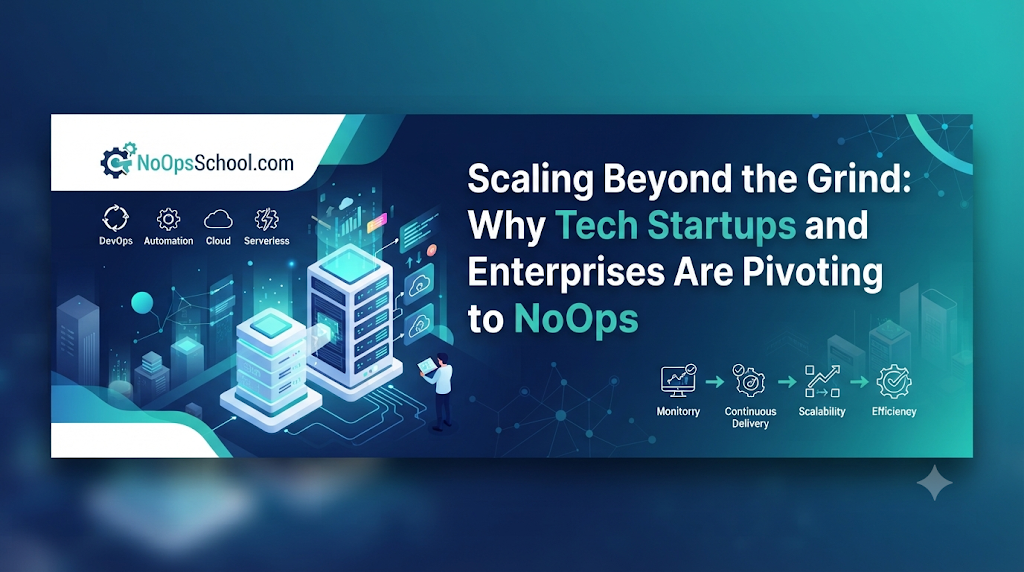
If you spend any time talking to modern software engineers or startup CTOs, you will notice a common undertone of fatigue. We live in an era of incredible technological velocity where applications can be spun up globally in seconds. Yet, beneath that high-speed agility lies a heavy anchor: the constant, grinding operational toil required to keep complex systems alive.
Between fighting brittle deployment pipelines, tracking down stubborn configuration drift across multi-cloud environments, and waiting on internal IT ticket queues just to get a test environment running, valuable engineering hours evaporate. Traditional management models are simply straining under the weight of cloud-native growth.
That growing friction is exactly why forward-thinking teams are shifting toward a smarter, automated paradigm: NoOps.
Decoding the Movement: What Is NoOps?
When people first run into the term, a wave of skepticism usually follows. Does “No Operations” mean servers magically maintain themselves while everyone logs off? Are system administrators heading toward extinction?
In practice, what is NoOps is not about erasing responsibility; it is about radical abstraction and total automation. In a true NoOps workflow, everyday infrastructure maintenance is handled completely by code and platform engines. Developers write their application code and declare what resources they need in version-controlled configuration files. Automated pipelines, continuous delivery tools, and self-healing systems take care of the rest—provisioning, scaling, security checks, and recovery happen without human intervention.
Instead of filing IT requests, your infrastructure becomes a clean, self-service API.
NoOps vs DevOps: The Next Chapter in Tech Evolution
A lot of engineering circles love to debate NoOps vs DevOps. Some frame them like opposing teams, but they are really just consecutive chapters in the exact same technical evolution.
DevOps broke down the wall between developers and operations professionals, championing shared responsibility, collaborative pipelines, and automated testing. Even so, many teams running standard DevOps models still find developers getting sucked back into manual troubleshooting, deployment firefighting, and stressful on-call shifts.
NoOps takes those automation wins and pushes them to their logical conclusion. Where DevOps establishes the continuous delivery foundation, NoOps builds a self-contained platform layer on top of it. Specialized platform engineers build the automation guardrails so that product developers can stay 100% focused on business logic.
The Toolchain Behind a Low-Touch System
Running a successful NoOps setup means stitching together a reliable, modern stack. The core pillars typically include:
- Infrastructure as Code (IaC): Defining servers, networks, and databases as version-controlled code using tools like Terraform.
- Containers & Kubernetes: Packaging apps cleanly so they run predictably and scale instantly across any cloud.
- GitOps Workflows: Using Git repositories as the absolute single source of truth for all infrastructure changes and application states.
- CI/CD Automation: Building airtight pipelines that automatically test, validate, and push code updates on every commit.
- Observability & AIOps: Deploying smart monitoring tools that detect anomalies and trigger self-healing scripts before anyone even has time to look at a dashboard.
When these pieces click together, spinning up a fresh environment takes minutes instead of days, and routine errors fix themselves in the background.
Leveling Up Your Career and Professional Credibility
As more companies shift toward low-touch environments, the demand for engineers who know how to build and govern these automated systems is skyrocketing.
If you want to validate your expertise, earning a recognized NoOps certification is a brilliant career move. Whether you want to sharpen your technical execution with a NoOps engineer certification, step into high-level system design via NoOps architect training, or master governance and team alignment through a NoOps manager certification, structured credentials carry serious weight.
For individuals and engineering teams looking for guided, role-specific learning, platforms like NoOpsSchool.com offer specialized training courses and certification tracks designed to bridge the gap between abstract concepts and hands-on production mastery.
When Enterprises Need Extra Backup
Moving an entire organization toward an automated operating model is rarely a walk in the park. Legacy systems, messy deployment pipelines, and strict compliance hurdles can stall progress fast.
During these transformations, companies often lean on external NoOps consulting services to audit workflows, modernize cloud architectures, and set up strict security-as-code policies. Similarly, if an internal team needs dedicated bandwidth for a major migration, knowing how to hire NoOps freelancers who deeply understand container orchestration and declarative code can save months of trial and error.
The Human Factor: Where Engineering Judgment Still Rules
It’s vital to stay realistic: automation isn’t a silver bullet. Poorly written automation scripts can propagate configuration errors across a distributed network at terrifying speeds.
Human engineers remain entirely responsible for architectural decisions, handling complex or novel system failures, auditing security policies, and steering long-term strategy. NoOps eliminates repetitive toil and operational friction, but it relies on skilled human minds to design, supervise, and steer the underlying platforms.
Final Thoughts
The future of software delivery belongs to automation-first engineering, intelligent monitoring platforms, and continuous technical growth. Whether you’re an individual developer sharpening your skill set or an enterprise transforming its architecture, embracing structured training and expert guidance is the surest path forward. Explore the specialized resources and training paths available at NoOpsSchool.com to start mastering the future of IT operations today.
Leave a Reply