Navigating the Skies and Beyond: A Comparative Guide to Pilot Careers and Astronaut Training
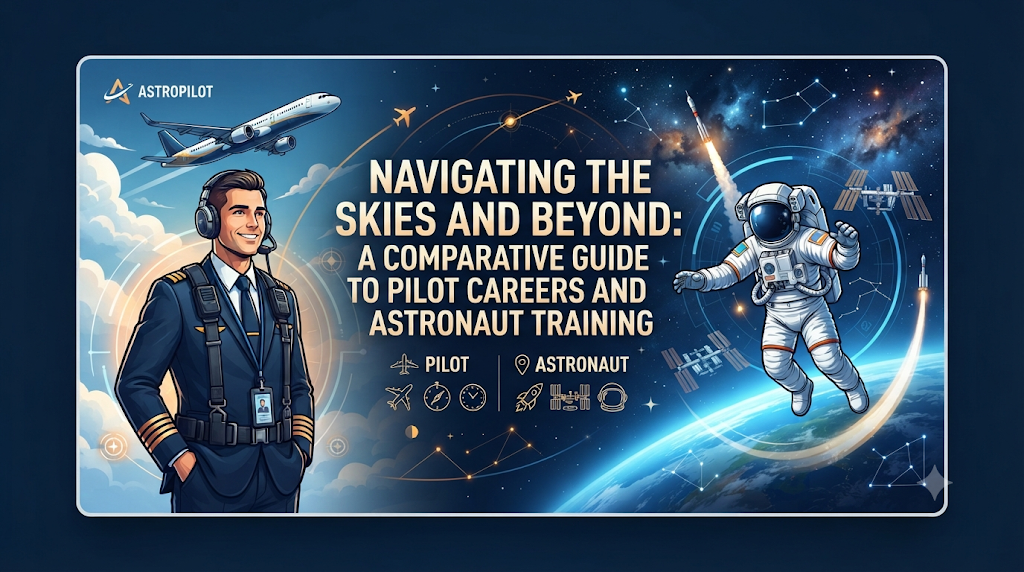
The human drive to conquer the vertical dimension has evolved dramatically. From the wooden frames and fabric wings of early aviation pioneers to the automated glass cockpits of modern commercial jets and autonomous spacecraft docking systems, exploring the vertical realm demands a unique blend of intellectual rigor, procedural discipline, and rapid situational awareness.
Yet, when we gaze upward, we often blur the line between two distinct vocational worlds: aviation and astronautics. Although both domains demand absolute precision, high-pressure decision-making, and mastery over complex machinery, their training pathways, environments, and core competencies are fundamentally distinct. Aspiring pilots and future spacefarers frequently encounter a maze of licensing requirements, regulatory standards, and career milestones.
Examining how these two elite disciplines overlap—and where they diverge—provides essential guidance for anyone planning a career in the aerospace industry.
The Aviator’s Journey: Airmanship, Groundwork, and Flight Dynamics
A professional pilot’s career follows a clearly defined, incremental ladder of competence. Long before an aviator commands a wide-body commercial airliner across intercontinental routes, they must master the fundamental physics of flight—lift, weight, thrust, and drag—from the control seat of a light training aircraft.
Establishing the Basics: The Private Pilot License
Every aviation career starts from the same baseline: the Private Pilot License (PPL). Whether a student trains under Federal Aviation Administration (FAA) regulations in the United States or Directorate General of Civil Aviation (DGCA) guidelines in India, the PPL is an introduction to fundamental airmanship, weather analysis, and aircraft control.
Student aviators quickly learn that flying is less about physical manipulation and more about risk management. Weather patterns, airspace restrictions, and aerodynamic stall recovery form the core of early education. For those exploring structured instruction, researching pilot training programs in the USA reveals a diverse landscape of collegiate programs and accelerated flight schools. However, a PPL does not authorize commercial compensation; it simply lays the groundwork for all future ratings.
Progressing to Commercial and Instrument Operations
Moving from a recreational aviator to a professional pilot requires targeted skill acquisition:
- The Instrument Rating (IR): Training pilots to fly strictly by onboard instrumentation, navigating safely through heavy cloud cover and zero-visibility conditions.
- The Commercial Pilot License (CPL): Elevating operational standards, requiring superior aircraft handling, and granting legal authorization for paid flight operations.
- Multi-Engine Certification: Preparing pilots to manage asymmetrical thrust, simulated engine failures, and complex aircraft subsystems.
The pinnacle of traditional civil aviation certification is the Airline Transport Pilot License (ATPL). Meeting airline transport pilot license requirements involves accumulating thousands of flight hours, mastering multi-engine turbine aircraft, and demonstrating seamless crew resource management. It is a rigorous, highly monitored journey designed to ensure absolute competence in routine and emergency scenarios alike.
Reaching for Orbit: The Evolution of Astronaut Training
While commercial pilots operate under strict civil aviation frameworks within the troposphere and stratosphere, astronauts function within an environment governed by orbital mechanics, hyperbaric physics, and international cooperation.
When students and young professionals investigate how to become an astronaut, they often discover that modern selection criteria go far beyond traditional military test pilot backgrounds. While military aviation remains an esteemed route—testing resilience under high-G loads—space agencies like NASA, ESA, and commercial aerospace companies actively seek diverse professionals, including research scientists, software engineers, and medical doctors.
Key Pillars of Astronaut Preparation
The training pipeline for a candidate astronaut is a rigorous, multi-year curriculum:
- Deep Technical Literacy: Candidates must understand spacecraft life support systems, orbital mechanics, and advanced robotics, such as operating manipulator arms in microgravity.
- Survival and Wilderness Conditioning: Rigorous water survival training, remote wilderness survival protocols, and geological field expeditions prepare crews for unplanned emergency landings.
- The Neutral Buoyancy Laboratory: Working underwater in full-scale spacecraft mockups helps candidates adapt to simulated microgravity, building muscle memory for complex spacewalks.
- High-Performance Flight and Hypoxia Training: Candidates utilize high-performance jets to maintain spatial orientation and undergo altitude chamber testing to recognize the physiological signs of oxygen deprivation.
For younger audiences exploring astronaut training for students, the focus lies on building strong foundations in STEM disciplines, collaborative problem-solving, and cross-cultural communication. Because modern space missions are collaborative international efforts, multilingual proficiency is often an asset.
Side-by-Side: Aviation Versus Spaceflight
Comparing pilot training and astronaut training side by side reveals distinct operational realities. While both professions command immense public admiration, their daily challenges and risk profiles differ significantly.
| Operational Factor | Professional Aviation (ATPL Path) | Human Spaceflight (Astronaut Operations) |
| Primary Operating Environment | Troposphere and stratosphere within civil air traffic control networks. | Low Earth orbit, lunar trajectories, and deep space exploration. |
| Governing Authority | Civil aviation regulators (FAA, DGCA, EASA, CASA, Transport Canada). | National space agencies (NASA, ESA, ISRO) and commercial space operators. |
| Primary Mission Objective | Safe, timely transportation of passengers and cargo. | Scientific research, technological testing, and exploration. |
| Failure Consequences | Immediate atmospheric hazard requiring emergency diversion or landing. | Catastrophic orbital system failure with minimal local rescue options. |
| Crew Autonomy | Independent flight deck crew coordinating with ground air traffic control. | Integrated coordination with massive mission control centers on Earth. |
This contrast explains why mastering one career does not automatically qualify an individual for the other. A veteran commercial captain possesses exceptional atmospheric awareness, but orbital rendezvous, radiation monitoring, and microgravity adaptation require an entirely separate educational skillset.
Simulators and Digital Learning Tools
In both aviation and astronautics, simulation technology serves as a vital training bridge. Long before an aviator handles real aircraft controls or an astronaut enters a full-motion capsule, digital simulation runs countless practice cycles.
In aviation education, consumer software has transformed how students understand complex instrument procedures. When exploring the best flight simulator software for student pilots, instructors look for realistic aerodynamic models and accurate navigation integration. While home simulators cannot replace certified flight instruction hours required for a private pilot license requirements checklist, they provide an exceptional cognitive playground for practicing radio calls and holding patterns.
Similarly, astronaut candidates spend thousands of hours inside high-fidelity fixed-base and motion-base simulators replicating complex spacecraft anomalies, ensuring rapid response under high-stress scenarios.
Charting Your Course
As the aerospace industry undergoes a massive transformation—driven by commercial spaceflight, advanced avionics, and electric aviation concepts—the pathways for ambitious learners are expanding rapidly.
Whether your ambition leads you to the flight deck of a commercial airliner navigating global routes or into the cabin of a next-generation spacecraft, success requires deliberate preparation and disciplined learning. Educational resources like AstroPilot help clarify these complex career pathways by breaking down regulatory hurdles and training requirements for aspiring aviators and space enthusiasts. By treating education as an ongoing flight plan rather than a single destination, you can build the skills needed to navigate whatever horizon you choose.
Leave a Reply