Architecting High-Concurrency Systems for the UK Live Events Industry
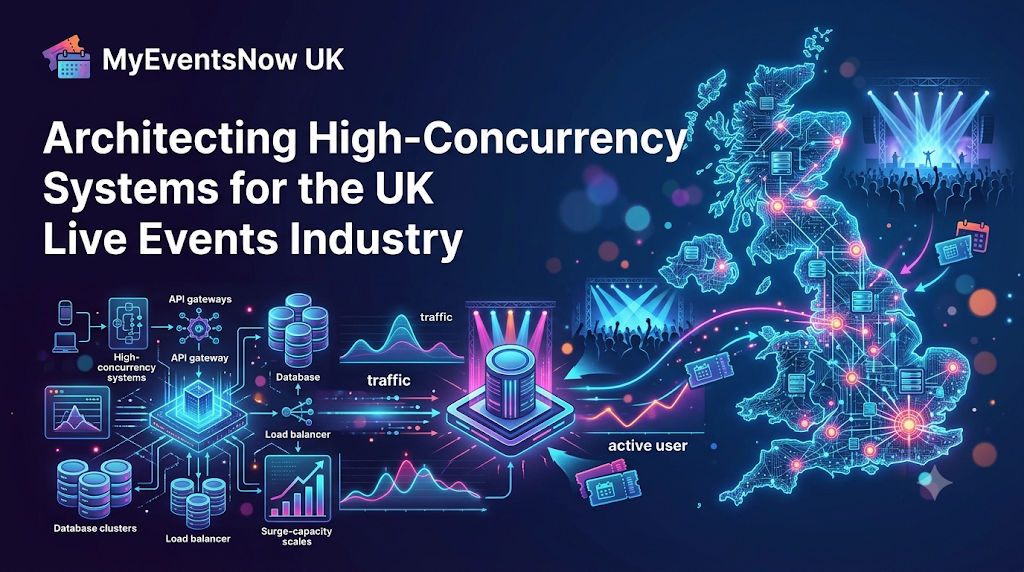
Few technical challenges stress an engineering team quite like a flash-crowd ticket drop. When a major tour, festival, or high-profile industry summit opens for registration, traffic does not ramp up along a predictable curve; it detonates. Within hundreds of milliseconds, an otherwise quiet system experiences an influx of tens of thousands of concurrent users, all competing for the exact same subset of database records. In traditional e-commerce, two shoppers rarely fight over the precise individual item down to the exact second. In live event ticketing, however, inventory is finite, uniquely allocated, and strictly time-sensitive. If ten thousand music fans in London, Manchester, or Glasgow click “Reserve Seat” simultaneously, a naive system will either deadlock at the database layer, succumb to race conditions that oversell the venue, or crash entirely under connection pool exhaustion.
For DevOps practitioners, site reliability engineers (SREs), and cloud architects, the live event sector provides a demanding proving ground. Building infrastructure capable of serving upcoming events in the UK requires orchestrating edge routing, distributed caching, decoupled queue workers, resilient database isolation, and real-time telemetry. Moving beyond standard web app patterns, engineering teams must deploy architectures that remain rock-solid under immense transactional pressure while maintaining absolute data integrity.
The High-Concurrency Dilemma: Why Standard Web Stacks Crumble
To understand why conventional web stacks fail during ticket sales, one must examine the fundamental nature of the transactional workload. A standard content platform or e-commerce storefront enjoys high read-to-write ratios. Read traffic can be cached aggressively across Content Delivery Networks (CDNs), edge layers, and distributed key-value stores.
Ticketing flips this operational model upside down. During an on-sale event, the dominant operation is an atomic state modification: verifying availability, locking an inventory row, generating a time-bounded reservation, and attaching a shopping session.
+-----------------------------------------------------------------------------------------+
|                        THE CONCURRENCY BOTTLENECK IN TICKETING                          |
+--------------------------+--------------------------------------------------------------+
| Operational Stage        | Technical Failure Mode Under Sudden Flash Load               |
+--------------------------+--------------------------------------------------------------+
| CDN Ingress              | Cache bypasses caused by unique session tokens and cookies.  |
| API Gateway              | Worker process exhaustion; socket starvation at connection.  |
| Cache Layer (Redis/Mem)  | Hotkey saturation when thousands mutate the same event key.  |
| Relational DB (RDBMS)    | Row-level lock contention, deadlocks, connection timeouts.   |
| Payment Gateway          | Third-party API rate limits, webhook delivery backlogs.      |
+--------------------------+--------------------------------------------------------------+
The Hotkey and Lock Contention Problem
Consider a concert in an intimate 2,000-capacity venue. When tickets go live, ten thousand requests arrive within five seconds. If those requests attempt to query and update a relational database using standard row-level locking (SELECT ... FOR UPDATE), the database engine must serialise those transactions.
The resulting queue of waiting transactions rapidly exhausts the database connection pool. Thread memory consumption spikes, context switching overwhelms the CPU, and downstream API services begin timing out. What follows is a cascading failure: front-end servers back up waiting for database responses, ingress proxies queue inbound TCP connections, and the entire platform grinds to an unrecoverable halt.
The Two-Phase Reservation State
Ticketing cannot rely on simple decrement counters. An attendee selecting four general admission tickets or specific balcony seats initiates a two-phase commit:
- The Temporary Hold: The seats are removed from general availability for a defined window (typically eight to ten minutes) to give the buyer time to enter billing and attendee information.
- The Settlement or Release: If payment succeeds, the hold transitions into a permanent allocation. If the user abandons the checkout or payment fails, the lock must expire cleanly, returning the inventory to the pool without manual intervention or race conditions.
Managing hundreds of simultaneous, expiring reservations across distributed nodes without causing inventory drift requires deliberate architectural patterns.
Architectural Anatomy of a Resilient Event Platform
High-performance online event ticket booking UK platforms solve this bottleneck by decoupling the user-facing web tier from the underlying transactional ledger. Instead of treating checkout as a synchronous request-response flow, modern architectures implement asynchronous, event-driven pipelines.
                           ┌─────────────────────────────┐
                           │      Global CDN / Edge      │
                           │  (WAF, DDoS, Bot Filtering) │
                           └──────────────┬──────────────┘
                                          │
                                          ▼
                           ┌─────────────────────────────┐
                           │    Virtual Waiting Room     │
                           │    (Token-Bucket Ingress)   │
                           └──────────────┬──────────────┘
                                          │
                                          ▼
                           ┌─────────────────────────────┐
                           │   Decoupled Reservation API │
                           │  (Redis Cluster / In-Memory)│
                           └──────────────┬──────────────┘
                                          │
                    ┌─────────────────────┴─────────────────────┐
                    ▼                                           ▼
         ┌─────────────────────┐                     ┌─────────────────────┐
         │ Async Message Queue │                     │ Persistent Storage  │
         │  (Kafka / RabbitMQ) │                     │ (Postgres / Aurora) │
         └──────────┬──────────┘                     └─────────────────────┘
                    │
                    ▼
         ┌─────────────────────┐
         │ Payment & Webhook   │
         │ Background Workers  │
         └─────────────────────┘
1. Edge Mitigation and Virtual Queuing
The most effective way to prevent database saturation is to prevent excess traffic from ever hitting core application servers. Edge infrastructure—leveraging edge computing runtimes such as Cloudflare Workers or AWS Lambda@Edge—serves as the first line of defence.
When traffic exceeds predefined thresholds, the edge layer automatically shifts incoming visitors into a cryptographically verified virtual waiting room. Each user is assigned a signed, time-stamped token (often backed by HMAC algorithms) that establishes their position in a FIFO queue. The edge gateway admits users downstream in controlled batches that match the verified transactional capacity of the database cluster.
This mechanism protects core infrastructure from raw connection volume, transforming an unpredictable spike into a flat, predictable processing stream.
2. In-Memory Distributed Locking with Redis
To handle inventory allocation without thrashing persistent disk storage, platforms deploy in-memory data structures. Redis clusters, configured with appropriate replication and persistence settings (such as append-only files with fsync every second), handle the rapid lock-acquire-release cycle.
Using atomic Redis operations or embedded Lua scripts, an inventory check and reservation can be executed in a single sub-millisecond step:
Lua
-- Atomic ticket reservation snippet in Lua for Redis
local event_key = KEYS[1]
local requested_tickets = tonumber(ARGV[1])
local session_id = ARGV[2]
local hold_ttl = tonumber(ARGV[3])

local available = tonumber(redis.call('HGET', event_key, 'available_count'))

if available and available >= requested_tickets then
    redis.call('HINCRBY', event_key, 'available_count', -requested_tickets)
    redis.call('SET', 'hold:' .. session_id, requested_tickets, 'EX', hold_ttl)
    return 1 -- Reservation successful
else
    return 0 -- Insufficient inventory
end
By executing this logic inside an atomic Lua script, Redis guarantees that no two concurrent requests can evaluate the available count simultaneously and oversell the allocation. The relational database is completely shielded from these rapid, exploratory checks.
3. Asynchronous Persistence via Event Streams
Once an in-memory reservation is established, the application publishes a message to an event bus such as Apache Kafka or RabbitMQ. Dedicated worker pools consume these messages to update relational ledgers, prepare billing profiles, and reserve physical seating charts.
If an external payment processor experiences latency, the asynchronous worker handles retries through dead-letter queues without holding user-facing HTTP connections open. The user interacts with a lightweight, responsive status endpoint that polls for settlement confirmation.
Infrastructure Considerations Across the UK Market
Deploying an event ticketing platform UK infrastructure team must take into account distinct geographic and regional factors. While cloud providers abstract physical hardware, network latency and regional routing play a significant role in user experience and data compliance.
+-----------------------------------------------------------------------------------------+
|                           REGIONAL CLOUD ROUTING PATTERNS                               |
+--------------------------+--------------------------------------------------------------+
| Factor                   | Architectural Best Practice                                  |
+--------------------------+--------------------------------------------------------------+
| Edge Latency             | Deploy points-of-presence across London, Manchester, Slough. |
| Read Scaling             | Geo-replicated read replicas for event discovery feeds.      |
| Regulatory Residency     | Data isolation within UK data regions (e.g., eu-west-2).     |
| Failover Redundancy      | Multi-AZ deployments with automatic cross-zone DNS routing.   |
+--------------------------+--------------------------------------------------------------+
Mitigating Latency for Regional Audiences
Events in London account for a significant share of transaction volume, but regional activity across Manchester, Birmingham, Bristol, Glasgow, and Edinburgh requires fast local routing. A user attempting to secure high-demand concert tickets UK promoters put on sale in Leeds should not experience unnecessary routing hops to European mainland servers before reaching application logic.
Deploying within UK-specific data centres (such as the eu-west-2 London region in AWS or the UK South region in Azure) ensures low network round-trip times. Coupled with distributed edge caches at local Internet Exchange Points (IXPs) like LINX (London) and IXManchester, static assets, seating maps, and initial venue metadata load near-instantly regardless of the user’s local broadband or 5G connection.
UK GDPR and Data Sovereignty
From an infrastructure compliance standpoint, managing event registrations requires strict adherence to the UK General Data Protection Regulation (UK GDPR) and the Data Protection Act 2018. DevOps pipelines must enforce:
- Encryption at Rest and in Transit: Mandatory TLS 1.3 for all ingress communication, coupled with envelope encryption for persistent databases using customer-managed keys.
- Separation of PII from Analytical Logs: Ensuring that access logs, distributed traces, and log aggregators (e.g., OpenSearch, Grafana Loki) scrub payment data, postal addresses, and telephone numbers before ingestion.
- Geographical Data Boundaries: Storing attendee databases within sovereign UK cloud regions, ensuring that cross-border data replication adheres to standard contractual clauses and adequacy regulations.
The Role of Modern Event Management Platforms
As ticketing workflows evolve, businesses, venues, and independent promoters require platforms that balance heavy cloud engineering with approachable publishing interfaces. Modern event registration software UK organizers rely on must provide low-latency performance during ticket drops while remaining simple enough for local community planners, educational institutions, and corporate event managers to use without deep DevOps expertise.
In this space, consolidated platforms such as MyEventsNow UK illustrate how modern event management software UK systems can combine scalable cloud discovery workflows with straightforward publishing tools. By handling ticket booking, organiser management, and regional event discovery within a unified architecture, such platforms allow organisers across England, Scotland, Wales, and Northern Ireland to list your event online UK audiences can easily find, avoiding the need to stitch together custom databases, API proxies, and payment plugins independently.
When the technical foundation of an event platform is engineered correctly, organisers can focus on programme quality and community engagement, confident that their infrastructure will not buckle under an unexpected influx of bookings.
Observability, Telemetry, and Load Simulation
You cannot stabilise what you do not measure. In an environment where load can swing by three orders of magnitude in ten seconds, traditional periodic polling (such as polling CPU metrics once a minute) is fundamentally inadequate. By the time a monitoring agent registers that a server is at 98% CPU utilisation, the service has likely crashed.
+-----------------------------------------------------------------------------------------+
|                             OBSERVABILITY STACK FOR TICKETING                           |
+--------------------------+--------------------------------------------------------------+
| Telemetry Domain         | Implementation Strategy                                      |
+--------------------------+--------------------------------------------------------------+
| Real-Time Metrics        | 1-second scraping intervals via Prometheus for queue depth.  |
| Distributed Tracing      | OpenTelemetry spans tracking checkout from edge to database. |
| Log Aggregation          | Structured JSON logs with trace ID correlation in Loki/ELK.  |
| Synthetic Traffic Testing| Distributed load testing (k6, Locust) matching sale curves.  |
+--------------------------+--------------------------------------------------------------+
High-Resolution Metric Collection
Production ticketing architectures require sub-five-second metric scraping for critical indicators:
- Redis Connection Counts and Memory Fragmentation: Spotting memory pressure before Redis starts evicting active keys.
- Database Active vs Idle Connections: Tracking connection pool exhaustion in real time.
- Queue Ingress vs Egress Rates: Alerting when message consumers fall behind incoming purchase requests.
- Payment Gateway Round-Trip Time: Detecting external API degradation before it cascades into client-side timeouts.
Distributed Tracing with OpenTelemetry
Implementing OpenTelemetry instrumentation throughout the request lifecycle allows engineers to trace every checkout transaction across API gateways, cache nodes, queuing buses, and database pools. If an individual request experiences latency, traces instantly reveal whether the delay stemmed from a slow third-party address-lookup service, lock contention in Redis, or an external card settlement endpoint.
Chaos Engineering and Realistic Load Profiling
Testing a ticketing platform requires more than sending a sustained stream of flat HTTP requests. Real human behaviour during ticket drops is chaotic and aggressive: users open multiple browser tabs, hit hard refreshes (F5), click checkout buttons repeatedly, and abandon carts halfway through the flow.
       Requests/Sec
           ▲
           │                                 ┌─┐
   15,000 ─┤                                 │ │  ◄── Flash Spike (On-Sale Moment)
           │                                 │ │
   10,000 ─┤                                ┌┘ └┐
           │                               ┌┘   └┐
    5,000 ─┤                       ┌───────┘     └────────┐
           │     Normal Traffic    │                      │  Graceful Drain
        0 ─┴───────────────────────┴──────────────────────┴────────► Time
Using tools like k6 or Locust distributed across cloud regions, engineering teams run automated chaos experiments:
- The Sudden Step Function: Simulating an instant jump from 100 requests per second to 20,000 requests per second to verify auto-scaling behaviour and edge waiting room triggers.
- Payment Gateway Latency Injection: Artificially introducing a three-second latency to 20% of external payment requests to verify that background workers decouple cleanly and do not stall the user-facing web tier.
- Database Read-Replica Partitioning: Simulating the failure of an availability zone to verify that discovery traffic seamlessly shifts to surviving read-replicas without data loss.
Defensive Engineering: Bot Mitigation and Inventory Hoarding
A major threat to live event availability is automated bot traffic. Scalpers and secondary market brokers deploy headless browsers, automated scripts, and distributed proxy networks to sweep up valuable inventory within seconds of a sale going live, seeking to sell event tickets online UK secondary exchanges at inflated prices.
DevOps engineers must implement multi-layered anti-bot strategies to preserve platform integrity.
                       ┌───────────────────────────────┐
                       │     Inbound HTTP Request      │
                       └──────────────┬────────────────┘
                                      │
                                      ▼
                       ┌───────────────────────────────┐
                       │   TLS & TCP Fingerprinting    │
                       │   (Detect JA3/JA4 Anomalies)  │
                       └──────────────┬────────────────┘
                                      │
                    ┌─────────────────┴─────────────────┐
                    │ Passed                            │ Failed
                    ▼                                   ▼
         ┌─────────────────────┐             ┌─────────────────────┐
         │ Proof-of-Work Challenge│          │ Hard Block / Drop   │
         │ (Non-intrusive PoW) │             │ (TCP Reset)         │
         └──────────┬──────────┘             └─────────────────────┘
                    │
                    ▼
         ┌─────────────────────┐
         │ Behavioural Analysis│
         │ (Mouse/Touch Checks)│
         └──────────┬──────────┘
                    │
                    ▼
         ┌─────────────────────┐
         │ Legitimate Attendee │
         │ Granted Access      │
         └─────────────────────┘
1. TLS and TCP Fingerprinting (JA3/JA4)
Automated scripts utilizing libraries like requests, aiohttp, or standard headless browsers exhibit distinct TLS handshake patterns. By evaluating the cipher suites, elliptic curves, and extension orders presented during the TLS negotiation, edge security services generate JA3/JA4 fingerprints. Requests matching known scraping frameworks can be challenged or dropped at the network perimeter before consuming application compute cycles.
2. Proof-of-Work (PoW) Edge Challenges
Traditional CAPTCHAs introduce significant user friction, frustrating genuine attendees rushing to book. Modern platforms increasingly deploy invisible, non-intrusive Proof-of-Work challenges executed in background JavaScript threads.
A client browser must calculate a cryptographic puzzle requiring moderate CPU compute before submitting a checkout payload. While negligible for a single human user (requiring 200–400 milliseconds of background processing), this challenge imposes massive computational overhead on bot networks attempting to fire ten thousand concurrent checkout scripts, rendering brute-force automated scraping economically and technically unviable.
3. Rate-Limiting with Token Buckets and Leaky Buckets
Rate limiting must be applied granularly. Global IP-based rate limiting is insufficient, as modern botnets rotate across thousands of residential proxy IP addresses. Instead, platforms apply token-bucket algorithms tied to unique combinations of:
- User device fingerprints
- Authenticated session IDs
- Payment card fingerprints
- Geolocation subnet heuristics
Restricting the rate of ticket reservation attempts per device ensures that bad actors cannot monopolise inventory, giving genuine fans equal footing when looking for events near me or securing festival passes.
Database Architecture: Sharding, Partitioning, and Consistency
At the core of any ticketing system lies the persistent datastore. When designing for massive concurrency, architects must choose their consistency models deliberately.
+-----------------------------------------------------------------------------------------+
|                           DATABASE ARCHITECTURAL TRADE-OFFS                             |
+--------------------------+--------------------------------------------------------------+
| Strategy                 | Benefits and Operational Trade-Offs                          |
+--------------------------+--------------------------------------------------------------+
| Read/Write Splitting     | Read replicas handle event discovery; write-master isolated.  |
| Sharding by Event ID     | Partitions database connections; prevents cross-event locks. |
| Event Sourcing           | Complete audit trail of ticket states; complex replay logic. |
| Optimistic Concurrency   | High throughput; relies on version numbers and retry loops.  |
+--------------------------+--------------------------------------------------------------+
Sharding by Tenant or Event ID
In a multi-tenant ticketing platform, a high-demand stadium concert in London should never degrade the database performance of a small poetry reading in Bristol. To achieve tenant isolation, platforms partition relational databases horizontally by event_id or organisation_id.
By sharding database instances, read and write operations for a specific event are routed to a dedicated database shard or partition key. The blast radius of a massive flash-crowd on-sale is strictly contained within its assigned cluster shard, ensuring that the wider platform continues to operate smoothly.
Optimistic Concurrency Control (OCC)
Where relational updates are necessary, high-scale ticketing architectures favor optimistic concurrency control over pessimistic row locks. Instead of locking a record with SELECT FOR UPDATE, each inventory row includes a version column:
SQL
UPDATE ticket_tiers
SET available_count = available_count - 2,
    version = version + 1
WHERE id = 'tier_ga_101'
  AND version = 4
  AND available_count >= 2;
If another worker thread updated the version in the millisecond between read and write, the update returns zero affected rows. The application detects the concurrent modification and either retries the transaction or prompts the user with an updated availability status. This eliminates long-held locks, allowing the database to process queries with maximum parallelism.
Blue-Green Deployments and Zero-Downtime Maintenance
In the live entertainment industry, there is no true “off-peak” window. When evening events in the UK end, promoters use late-night hours to publish schedules for upcoming events in the UK, reconcile daily door takes, and export accounting reports. Morning brings business conference registrations, and lunch breaks trigger ticket sales for weekend theatre and comedy tours.
DevOps engineers must maintain continuous zero-downtime deployment pipelines.
                                Production Router
                                       │
                    ┌──────────────────┴──────────────────┐
                    │                                     │
           Active (100% Traffic)                 Staging (0% Traffic)
                    ▼                                     ▼
        ┌───────────────────────┐             ┌───────────────────────┐
        │  Blue Fleet (v1.4.2)  │             │  Green Fleet (v1.4.3) │
        │  • Production Load    │             │  • Pre-Warm Caches    │
        │  • Live Connections   │             │  • Run Smoke Tests    │
        └───────────────────────┘             └───────────────────────┘
Decoupling Schema Migrations from Code Deployments
The primary impediment to continuous deployment in transactional systems is database schema evolution. Applying a locking ALTER TABLE statement on an inventory table with millions of historical rows can cause instant table locks and operational outages.
Resilient engineering teams employ the Expand and Contract pattern:
- Expand: Add new columns or tables alongside existing structures without altering current queries. Deploy database migrations independently of application code.
- Dual-Writing: Update the application to write to both old and new schema structures while continuing to read from the old structure.
- Cutover: Switch the application’s read paths to the new schema once data consistency is verified.
- Contract: Remove the obsolete columns and legacy tables in a subsequent maintenance cycle.
Coupled with container orchestration via Kubernetes and automated blue-green or canary routing through service meshes (such as Istio or Linkerd), new platform features can be deployed smoothly without interrupting an active ticket sale.
Building for the Future of Event Infrastructure
The technical foundation supporting live entertainment continues to evolve. As audience habits shift and ticket drops experience sharper, more concentrated demand, the systems powering event discovery, ticket allocation, and entry validation must become increasingly resilient, modular, and observable. Building platforms capable of handling sudden flash crowds requires moving past simplistic CRUD patterns. By shifting traffic management to the network edge, using in-memory distributed locks for state changes, decoupling processing through event streams, and designing databases with partition isolation, engineering teams can build platforms that withstand intense concurrency without compromising the attendee experience.
In the fast-moving UK live events ecosystem, reliability is not just a behind-the-scenes engineering metric; it is the cornerstone of consumer trust. When infrastructure performs flawlessly during peak traffic, event organisers can run ambitious gatherings, and audiences can secure their tickets with confidence, knowing the platform beneath them is built to handle the load.
Leave a Reply